
Building and Maintaining Lasting Relationships – Our Small Business Relationships Cheat Sheet from Connect
While we haven’t attended Stanford, we consider ourselves lucky to have recently attended a Zoom talk by founder of the popular “Touchy Feely” class, David Bradford, and read the class book, authored by David and Carole Robin, Connect: Building Exceptional Relationships with Family, Friends, and Colleagues. The book shows us how to cultivate exceptional relationships for richer and more meaningful life both inside and outside the office and is brimming with actionable tools – too many to remember unless put into practice. To help, we created a cheat sheet on small business relationship building based on the key learnings of the book. Below we attempt to fit their tools into three categories: Booting/running relationships, relationship glitches, and relationship crashes. Some might scoff at a relationship metaphor using hardware and software terminology but we’d argue that it is important to have rigid templates for interactions as a fallback until personal experience can better guide.
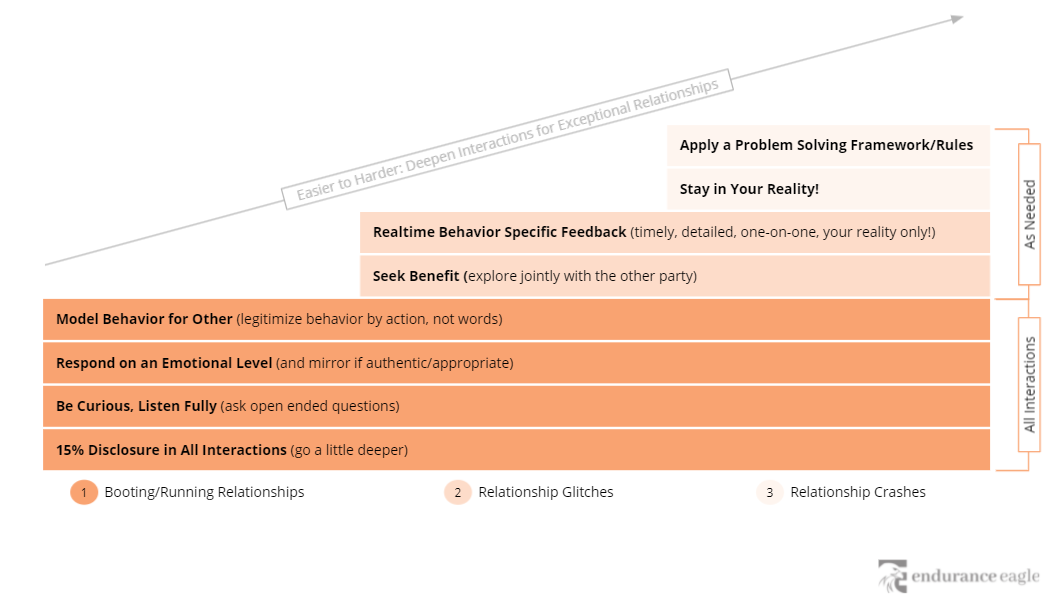
Small Business Relationship Building Cheat Sheet from Connect

How to Build Small Business Relationships (from Connect)
Booting/Running Relationships
Starting a new relationship or building an existing one towards exceptional has a few key steps that should be applied. These steps are at the bottom of our hierarchy because they are the foundation for all exceptional relationships.
- Be Curious, Listen Fully: Sometimes called active listening, be curious about the other person’s experiences. Unpack how it made them feel, ask open questions (yes/no questions are a no no), use empathy to reflect on how that might have made you feel/act and share that reflection. Make the conversation about their experiences, not just waiting for your moment to talk.
- 15% Disclosure in All Interactions: When it is your time to share (it will come), consider sharing more than the surface-level, go deeper. Share your fears, your desires, your weaknesses. David had a phrase he used: “Dropping a little deeper.” Share just 15% more of yourself in each interaction to build a stronger bond. That might be too little for you, but it certainly isn’t too much. Strive to share beyond your comfort zone.
- Respond on an Emotional Level: We’re emotional animals and it’s silly to deny that. Instead, embrace your feelings and empathy for the other person to increase your connectedness. If appropriate, use your internal feelings for what he/she is saying to show your empathy. David and Carole suggest statements like, “I would certainly be annoyed if that happened to me,” or “That sounds really upsetting,” because they reflect how those might make you feel and don’t label the other person (you’re likely to get the label wrong If you say something like, “you sound upset.”)
- Model Behavior for Others: This one is specific to leadership. Leaders in groups and organizations legitimize behavior by modeling for others to see. When you, as the leader of a small business, show the team that actively listening, being vulnerable, and disclosing is important you make it safe for others to do the same.
Relationship Glitches
The book talks about relationship imbalances and conflicts and gives us tools for both. What’s the difference? Well, we’re not sure. We might have missed it, but it might also be that there are shades of grey between when a relationship is in imbalance or conflict. It’s like Justice Stewart’s comment on obscenity: “you’ll know it when you see it.” To that end, we think of imbalance like “glitches,” disruptions that should be addressed but don’t require an overhaul. In those instances, use these tools:
- Seek Benefit: This might sound like the old, “win win” strategy. But the key here is to explore a solution together. Ask open ended questions like, “how did we end up here?” Seek to unpack a solution that works for the other person too and then check-in to make sure it works for them with active listening.
- Realtime, Behavior Specific Feedback: Feedback is a potent tool for correcting behavior, but only when it is timely and specific. Find the next possible moment of one-on-one interaction and share feedback on just that interaction so that the other person has an immediate opportunity to improve. Feedback is hard/dangerous (it can be taken poorly) so give feedback only on a behavior and not outcomes. Said differently, stay in your reality about the event (repeated below because this is so important) – only give feedback on how the event made you feel and not on how others were potentially impacted by event. The other person will have a hard time arguing how you felt or you were impacted, so it’s more likely he/she will accept/listen to the feedback then.
Relationship Crashes
At the risk further alienating readers by mixing hardware and software metaphors, we feel that a crash is more serious than a glitch. A crash means the program/relationship stops and must be fixed. All exceptional relationships have conflict. Will you let it destroy the relationship or seek resolution to make it stronger?
- Stay in Your Reality: It’s important to repeat this because it’s hard to remember and critical to success. You cannot fully understand another’s experiences, emotions, thoughts. Trying to understand them is great for building trust, but labeling it destroys trust. Instead of labeling him/her, focus on how you feel, how you experienced the moment to give that other person insight on you. David and Carole call this, “Staying on your side of the net” which is a good visual to keep in mind.
- Apply a Problem Solving Framework/Rules: Once conflict has started, it’s important to have a system of steps to address it. David and Carole have a great one (summarized below) but it’s not the only one. What’s important here is to pause, reflect, and actively decide to follow a system to reduce error. Why? Most of us are not conflict resolution experts and don’t have that many “at bats” with conflict situations. A template allows us to apply the learnings from experts and avoid mistakes that could make the conflict worse. Here’s David and Carole’s template:
- Stage 1: Get the other person to take the feedback seriously
- Stage 2: Each person shares all the issues for his/herself
- Stage 3: Find a mutually satisfying resolution for all parties
- Stage 4: Determine if relationship needs repair work
Using these tools is a great step in getting to exceptional relationships, but it won’t always be possible to go deeper with everyone. That said, the ones that do will have more value for your small business. We’re not doing this fantastic book justice, so go read the book. Additionally, the book explores a concept called T Groups by Kurt Lewin, which is worth further exploration. We’re just getting into the concept and might have more to say on that in another post.
As always, if you’re looking for a team that’s willing to drop a little deeper and build a lasting relationship with you and your small business, contact us at Endurance Eagle about selling your small business now.