Our Small Business CEO Leadership Principles Updated for 2022 (and Notes from Kim Scott’s Radical Candor)

Our Small Business CEO Leadership Principles Updated for 2022 (and Notes from Kim Scott’s Radical Candor)

If you’ve read our small business CEO Leadership Principles 2020 Edition (we didn’t author a 2021 edition, it was a busy year), you know the core values that guide how we work and lead small business teams. While these values are important to us, we subscribe to strong opinions weakly held from Paul Saffo and thus like to revisit our leadership principles for possible revisions. Recently, reading two books has pushed us to add a new principle: Caring deeply and challenging directly.

How did we get from three principles to four? Two books read back-to-back that were more connected than they might seem on the surface. Connect by David Bradford and Carole Robin (we wrote about building connections in small businesses) and Radical Candor by Kim Scott (more on her book below) showed us that leadership requires personal connections to build trust and direct feedback to drive results. Leadership is done through the relationships that the leader builds with each direct report. Those direct reports in turn model the leader’s style and build relationships with their direct reports. This pyramid of connection creates the pathways to getting things done in an organization at scale (beyond 5-6 direct reports it becomes too hard for a leader to interact with everyone in an organization, especially as they grow). Our new leadership value, “Caring Deeply and Challenging Directly” is a blend of the concepts from Kim Scott and David Bradford/Carole Robin that both speak to building strong relationships one-to-one (caring deeply) to promote trust (and psychological safety) and using that trust to drive improvement in outcomes through changes in processes/systems (challenging directly). While it is tempting to try and build relationships one-to-many, the reading of these books shows us that 1) relationships matter, 2) relationships/trust drives connection and results, and 3) a one-to-one culture is extremely difficult to duplicate, thus protecting the long-term success of an organization that takes the time to get it right. For us, that is worthy of being our fourth leadership principle.

Small Business CEO Principle One: Lead from Behind

The CEO’s job is building a sustainable and defensible business. To build a sustainable and defensible business, scaling is often necessary. To scale, a CEO’s must push his/her team to the front and empower them to be successful (this gives everyone leverage on his/her time and thus enables scale). Support can be listening, empathizing, training, compensation/incentives, more team members, or just empowering the team member as the decision-maker. The true power of the CEO is raising up others around the team to carry the mission forward.

Small Business CEO Principle Two: Measure for Alignment and Growth

What gets measured gets done. Measuring doesn’t just “track” what’s going on with a project, it forces us to think at a more granular level and understand the inputs that drive results. This is why measurement is so important. It’s not for understanding what happened last week or last month relative to the current time period, that’s important too, instead it is understanding how to execute and optimize that execution to materially change outcomes. We humans come to work in small businesses packed with biases (both good and bad). Measuring the inputs/outputs helps to mitigate some of those biases by making it about the results and improving those results (alignment of the team and growth of the outcome).

Small Business CEO Principle Three: Create a Culture of Done

Getting things done matters. Without execution, even the best business strategy in the world is worthless. Said differently, execution eats strategy for breakfast. We believe that a CEO of a small business has to get things done to be the example of what done looks like in his/her small business. This helps the team understand the speed and quality of done and also gives them an example of the CEO making mistakes (mistakes always happen) and the psychological safety of making mistakes (that are corrected).

Small Business CEO Principle Four: Care Deeply, Challenge Directly

Our three above principles lightly touch of the concepts of our new CEO Principle Number Four (e.g., you can’t lead from behind without listening and empathizing with your employee’s current position/needs), but caring deeply and challenging directly are so important in building successful small business work relationships, that we felt it must be explicitly stated. At the end of the day, we are all put on this planet to be part of relationships. We believe a true leader and CEO is actively building and growing those relationships. There is no better way to do that than to care deeply and challenge directly.

Post-Script: Additional Insights from Radical Candor

Kim Scott’s Radical Candor is full of insights and advice from her years leading the biggest companies in technology. It is impossible to build a list of all of her insights, but we captured a few that we are going to strive to implement into our leadership practice this year. We suggest you read the book if any of these insights spark your curiosity for more.

  • Leaders need feedback to survive. Don’t let your direct reports off the “feedback hook.” Kim makes the point that leaders need feedback just as much as their direct reports may need feedback. The challenge is that as a leader moves up the ranks it is harder to get honest feedback. In those moments, a leader must continue to press his/her direct reports to get that feedback that is critical to the growth of the leader and improvement of the organization. Kim’s favorite feedback question to direct reports: “Is there anything I could do or stop doing that would make it easier to work with me?”
  • Guidance and feedback must be as close to the moment as possible to improve performance. The closer your feedback is to the moment, the more meaningful the insight will be to your direct report (added bonus of you will not forgot to give the feedback if you do it immediately). When giving feedback, describe three things: 1) The situation you saw, 2) the behavior (always describe the behavior, not the person!), and 3) the impact you observed.
  • Find help to coach and support your team. Coaching and supporting your team shouldn’t be you coaching the team directly. You will become the bottleneck! Instead, find external resources and support systems to offer the same insight/support, without waiting for you to deliver it.
  • Align the role of your direct reports with their values. Employees that feel a connection to their career goals and values will be more insightful and impactful than those that are not connected to the work on a deeper level. Start having career conversations and value alignment with the three step career goals conversation: 1) Life story conversation, 2) Dreams conversation, and 3) 18-month plan conversation.

As always, if you’re looking for a team that has core values aligned with your own, contact us at Endurance Eagle about selling your small business now.

Building and Maintaining Lasting Relationships – Our Small Business Relationships Cheat Sheet from Connect

Building and Maintaining Lasting Relationships – Our Small Business Relationships Cheat Sheet from Connect

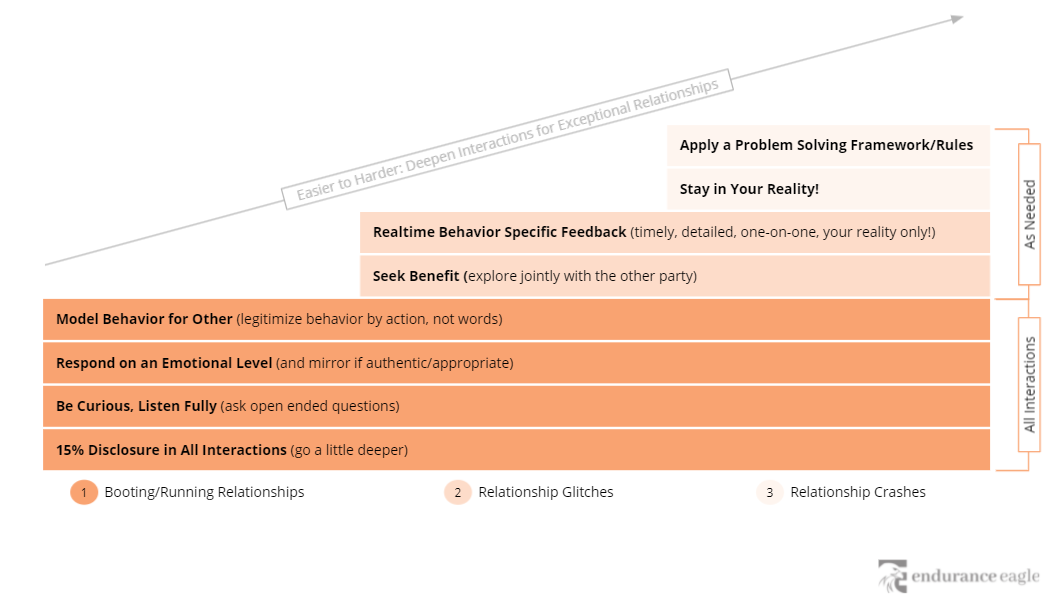
While we haven’t attended Stanford, we consider ourselves lucky to have recently attended a Zoom talk by founder of the popular “Touchy Feely” class, David Bradford, and read the class book, authored by David and Carole Robin, Connect: Building Exceptional Relationships with Family, Friends, and Colleagues. The book shows us how to cultivate exceptional relationships for richer and more meaningful life both inside and outside the office and is brimming with actionable tools – too many to remember unless put into practice. To help, we created a cheat sheet on small business relationship building based on the key learnings of the book. Below we attempt to fit their tools into three categories: Booting/running relationships, relationship glitches, and relationship crashes. Some might scoff at a relationship metaphor using hardware and software terminology but we’d argue that it is important to have rigid templates for interactions as a fallback until personal experience can better guide.

Small Business Relationship Building Cheat Sheet from Connect

How to Build Small Business Relationships (from Connect)

Booting/Running Relationships

Starting a new relationship or building an existing one towards exceptional has a few key steps that should be applied. These steps are at the bottom of our hierarchy because they are the foundation for all exceptional relationships.

  • Be Curious, Listen Fully: Sometimes called active listening, be curious about the other person’s experiences. Unpack how it made them feel, ask open questions (yes/no questions are a no no), use empathy to reflect on how that might have made you feel/act and share that reflection. Make the conversation about their experiences, not just waiting for your moment to talk.
  • 15% Disclosure in All Interactions: When it is your time to share (it will come), consider sharing more than the surface-level, go deeper. Share your fears, your desires, your weaknesses. David had a phrase he used: “Dropping a little deeper.” Share just 15% more of yourself in each interaction to build a stronger bond. That might be too little for you, but it certainly isn’t too much. Strive to share beyond your comfort zone.
  • Respond on an Emotional Level: We’re emotional animals and it’s silly to deny that. Instead, embrace your feelings and empathy for the other person to increase your connectedness. If appropriate, use your internal feelings for what he/she is saying to show your empathy. David and Carole suggest statements like, “I would certainly be annoyed if that happened to me,” or “That sounds really upsetting,” because they reflect how those might make you feel and don’t label the other person (you’re likely to get the label wrong If you say something like, “you sound upset.”)
  • Model Behavior for Others: This one is specific to leadership. Leaders in groups and organizations legitimize behavior by modeling for others to see. When you, as the leader of a small business, show the team that actively listening, being vulnerable, and disclosing is important you make it safe for others to do the same.

Relationship Glitches

The book talks about relationship imbalances and conflicts and gives us tools for both. What’s the difference? Well, we’re not sure. We might have missed it, but it might also be that there are shades of grey between when a relationship is in imbalance or conflict. It’s like Justice Stewart’s comment on obscenity: “you’ll know it when you see it.” To that end, we think of imbalance like “glitches,” disruptions that should be addressed but don’t require an overhaul. In those instances, use these tools:

  • Seek Benefit: This might sound like the old, “win win” strategy. But the key here is to explore a solution together. Ask open ended questions like, “how did we end up here?” Seek to unpack a solution that works for the other person too and then check-in to make sure it works for them with active listening.
  • Realtime, Behavior Specific Feedback: Feedback is a potent tool for correcting behavior, but only when it is timely and specific. Find the next possible moment of one-on-one interaction and share feedback on just that interaction so that the other person has an immediate opportunity to improve. Feedback is hard/dangerous (it can be taken poorly) so give feedback only on a behavior and not outcomes. Said differently, stay in your reality about the event (repeated below because this is so important) – only give feedback on how the event made you feel and not on how others were potentially impacted by event. The other person will have a hard time arguing how you felt or you were impacted, so it’s more likely he/she will accept/listen to the feedback then.

Relationship Crashes

At the risk further alienating readers by mixing hardware and software metaphors, we feel that a crash is more serious than a glitch. A crash means the program/relationship stops and must be fixed. All exceptional relationships have conflict. Will you let it destroy the relationship or seek resolution to make it stronger?

  • Stay in Your Reality: It’s important to repeat this because it’s hard to remember and critical to success. You cannot fully understand another’s experiences, emotions, thoughts. Trying to understand them is great for building trust, but labeling it destroys trust. Instead of labeling him/her, focus on how you feel, how you experienced the moment to give that other person insight on you. David and Carole call this, “Staying on your side of the net” which is a good visual to keep in mind.
  • Apply a Problem Solving Framework/Rules: Once conflict has started, it’s important to have a system of steps to address it. David and Carole have a great one (summarized below) but it’s not the only one. What’s important here is to pause, reflect, and actively decide to follow a system to reduce error. Why? Most of us are not conflict resolution experts and don’t have that many “at bats” with conflict situations. A template allows us to apply the learnings from experts and avoid mistakes that could make the conflict worse. Here’s David and Carole’s template:
    • Stage 1: Get the other person to take the feedback seriously
    • Stage 2: Each person shares all the issues for his/herself
    • Stage 3: Find a mutually satisfying resolution for all parties
    • Stage 4: Determine if relationship needs repair work

Using these tools is a great step in getting to exceptional relationships, but it won’t always be possible to go deeper with everyone. That said, the ones that do will have more value for your small business. We’re not doing this fantastic book justice, so go read the book. Additionally, the book explores a concept called T Groups by Kurt Lewin, which is worth further exploration. We’re just getting into the concept and might have more to say on that in another post.

As always, if you’re looking for a team that’s willing to drop a little deeper and build a lasting relationship with you and your small business, contact us at Endurance Eagle about selling your small business now.

New York State Business Brokers List for Selling New York Small Businesses

New York State Business Brokers List for Selling New York Small Businesses

We firmly believe selling a small business must involve a business broker. As we’ve said in older posts (Pennsylvania business broker list), business brokers are the intermediary that prepare both the buyer and seller for a successful transaction. Business brokers are incentivized by the transaction and future transactions, so they’re uniquely aligned to, 1) sell your business to the best possible party and price, and 2) ensure your goals are reasonably met so that you will refer future business (business listings often come from referrals, maintaining a sterling reputation is very important to business brokers). If you’re planning to sell a New York State small business, then start with our list of New York State business brokers list to find the broker that’s right for your business sale. When you start to meet brokers, we suggest you consider these interview questions in choosing the right broker.

  • Timing and Schedule? There are three big timing buckets in a business sale: The selling process, the diligence process, and the closing process. Get a sense from the broker about how long the transaction will take at each stage. Ask the broker what time commitments he or she will give your business and what time commitments you need to give to the broker. If the broker is not willing to get on the phone with you or provide concrete time commitments to your business upfront it might indicate that the broker will not be focused on transacting your business. Dig deeper by asking, “why” to understand the issues and be willing to move on if it does not align with your timing requirements.
  • What’s Out-of-Bounds and In-Bounds? Some brokers will aggressively market a business with business listing websites, e-mailing campaigns, etc. Others will reach out to curated set of buyers with a bespoke marketing campaign. It’s important for you to understand and accept the way the broker will sell your business before agreeing to sell your business with a broker. Make sure you discuss with your broker what tactics/strategies they’re going to use to sell your business and the visibility this will create for your business. If your business sale is confidential, then this is extremely important to understand before signing with a broker.
  • Successful Deal and Broken Deal References? Always ask for reference checks as a follow-up for brokers that you think might fit your need. Try to speak to a business owner that successfully transacted with the broker (either the previous owner or the new owner) and those that did not successfully transact with the broker. It will be harder to get “broken deal” references, but be persistent. Every broker has a broken deal and there’s a lot to learn from the failures.
  • Industry Experience? See if the business broker has experience transacting with other businesses in your industry (or adjacent industries). This is not critical to successfully selling your business, but it will help you understand if you think the broker can sell your type of business. Again, you may want to ask to speak to references from successfully closed transactions and transactions that didn’t close with a focus on your industry.
  • Professionals Agree? Check with your lawyer (and your lawyer’s lawyer friends) and accountant (and your accountant’s accountant friends) to find out what they know about the business broker. Have they worked with that business broker in the past? Do they know anyone that’s worked with the broker? What questions do they want to ask the broker? Your lawyer and accountant will be spending time with the broker, so they need to be comfortable with the broker as well.
  • Valuation Expectations? It is important that you agree with the broker on the valuation expectations of your business before signing an exclusivity agreement. Make sure the broker is honest with you about the value of your business so that sticker shock doesn’t factor in later in the sale process when it can damage a potential deal. You should expect the broker to push back on your initial valuation, use that as the starting point of a valuation conversation.

These questions put you on the right path to finding a good New York business broker (or business broker in any other state), but remember that selling your business is a two-way street. Just as you would expect the broker to be prepared and enthusiastic about your small business sale, you should be too. This means dedicating time to preparing the necessary financial statements and contracts for the broker to review and time to speak with potential buyers, weekly. Additionally, the more transparent you are with what your selling goals (e.g., highest valuation, fastest close, preserved legacy, employee retention, etc.) the more the broker can filter upfront to make sure he or she presents the buyer that fits your desired outcome. Transparency between you and the business broker will only make the process smoother.

A note on our List of New York State Business Brokers

Selling your New York business with a New York business broker puts you and your business on a surer path to successfully closing the transaction. Our New York business brokers list has 247 different business brokers and can help you get started in your process to sell your business. This list features all the brokers we’ve found that sell businesses in New York State and is not filtered for asset class (e.g., real estate business brokers vs. industrial business brokers), size of the business broker’s firm, quality of the business broker’s firm, or even if the business broker is actively seeking new listings. If you have questions about how to approach brokers, what to look for in a New York business broker, or want to learn about selling your New York Small Business to Endurance Eagle, contact us and we’d be more than happy to help.

NY Business Brokers List

Download our list of NY Business Brokers

Our Entrepreneurship Model for Small Business Updated with Systems Thinking

Our Entrepreneurship Model for Small Business Updated with Systems Thinking

At Endurance Eagle, we’re not precious about our models or frameworks. One of our favorite quotes is Paul Saffo’s, “strong opinions, weakly held,” which argues one should come to a conclusion and then challenge that conclusion’s assumptions to form a more useful opinion or strategy. We think that’s right on the money and also love the subtext of that philosophy which promotes speed of execution (or decision-making) to solve a business challenge while giving yourself (and your team) the flexibility to revise as new information arises. We bring up Saffo because we recently finished reading The E-Myth Revisited by Michael E. Gerber and realized our Entrepreneurship Model for Small Businesses was missing something that Gerber lays out in his book. Our model was our “strong opinion,” that we must adapt with new information. That information was Gerber’s thinking on systems design, what he calls the Franchise Model. It’s a component that we implicitly included in the last step of our model but realized it should be more clearly stated. So, we did.

There’s much of Gerber’s book and rules that we don’t agree with (it is written for a particular type of business), but his Franchise Model resonates with our years of experience in small business operating. His model’s goal is to ensure consistent output to maintain customer expectations as the business grows (a common problem when entrepreneurs move from “hands-on” to “hands-off”). This is done by establishing systems early in the company’s life to remove defect, key-man, or knowledge-loss risk in outputs. The rules of the Franchise Model are below. We don’t 100% agree with them (especially rule #2), so we’ve struck those rules that we don’t think are relevant to all businesses.

  1. Consistent value to customers employees, suppliers, etc.
  2. Model is operated by people with the lowest skill level
  3. Model will stand out as a place with impeccable order
  4. All work in the model will be documented in the operations manual
  5. The model will provide a uniformly predictable service to the customer
  6. Model will utilize a uniform color, dress, and facilities code

The Franchise Model is a good formalized version of a broad discipline called, “systems design.” His rules help a small business entrepreneur remember that systems are just as important as people in the success of a small business (having the right people/culture is important in small business development too, even if this is not part of Gerber’s model). We agree. Frankly, we’re a bit embarrassed that we didn’t explicitly include this in our original model (that’s how important we think it is to have good systems), but we’re happy to have it now after the adoption of the MVP step when scale becomes a reality for a small business.

Small Business Entrepreneurship Model

Once a system is in place it might be easy to assume that the process is done and that the business can now scale infinitely. This is dangerous thinking. A good system doesn’t move to the “scale” step of our Small Business Entrepreneurship Model, instead it becomes part of a recursive subroutine reset by a defined metrics. That’s why we call the final step, “Optimize and Scale.” At this stage, the business is constantly moving back and forth between the system and scale steps depending on the performance of the outputs.  It might seem exhausting to forever be in this cycle, but we believe that it is paramount to success in small business growth for the long-run.

Where do you start to implement systems? Gerber provides a few questions that small business leaders should ask themselves (we’ve lightly edited them here) as thought-starters:

  • How can I get my team to work without my interference or daily direction?
  • How do I get the 5,000th unit of production or service to be the same as the first one?
  • Do I know the output/measurement of each action in the business?
  • If I increase or decrease one output, do I know how it will impact other parts of the process/business?

There are many detailed frameworks for systems a company could implement and it would be impossible to choose one as the absolute truth. We believe different businesses will find success with different frameworks (or pieces of many frameworks), so having the goal of creating systems, will put you and your company on the right path and that’s at least 80% of the solution. That said, we enjoy the thinking and frameworks that Kevin Fishner created at HashiCorp as documented by First Round Review if you’re looking for additional reading.

One final note: We suspect that some followers of Gerber’s model might argue that Gerber’s rule of using the lowest skilled employee possible is a point about avoiding key-man risk and not an edict. That may be true, but we still feel that it’s a dated concept because it doesn’t empower the sharing of information and optimization from the bottom to the top of the company. We could (and might) write more on this, but HBR’s Execution Trap by Roger L. Martin does this perfectly, so we’ll let him do the talking (for now).

If you agree with our thinking and are looking to sell your small business in the next few years, we’d love to discuss finding a long-term home for your small business with Endurance Eagle.

Reframing to Make Your Small Business Resilient

Reframing to Make Your Small Business Resilient

A chance reading of Maria Konnikova’s reporting on the Secret Formula for Resilience for the New Yorker sent us into a deepish dive into resilient thinking and the models that have been created at Penn, Michigan State, Columbia, etc. The reason for so much of this research is summarized well by Konnikova:

One of the central elements of resilience, Bonanno has found, is perception: Do you conceptualize an event as traumatic, or as an opportunity to learn and grow? “Events are not traumatic until we experience them as traumatic,” Bonanno told me, in December. “To call something a ‘traumatic event’ belies that fact.”

…Take something as terrible as the surprising death of a close friend: you might be sad, but if you can find a way to construe that event as filled with meaning—perhaps it leads to greater awareness of a certain disease, say, or to closer ties with the community—then it may not be seen as a trauma. The experience isn’t inherent in the event; it resides in the event’s psychological construal.

Helping individuals to reframe an event, changes the interpretation of the event to the individual and allows for adaptation (and improvement). Said differently, give the individual the feeling of agency (change the locus of control from external to internal) and that person makes positive changes. From another Konnikova article (oddly this article is about the psychology of torture), we learned that that this was described by Dr. Martin Seligman as an individual’s explanatory style:

The cognitive program taught the kids to identify when they were having negative thoughts, to evaluate those thoughts objectively, and then to come up with alternatives. It also had them reframe any pessimistic explanations that they found themselves giving—my mom is sad, because I did something wrong—for more optimistic and realistic ones—my mom is sad, because she had a long day at work.

…At the end of the two years, forty-four per cent of the children in the control group had developed a form of depression. Only twenty-two per cent of the treatment group had done so. The improvements hinged largely on changes in the children’s explanatory style: the ones in the prevention group had learned how to create explanations that rendered them hopeful instead of hopeless.

There are countless articles on resiliency and reframing (some of which we’ve included). So, we carefully considered adding to the compendium before publishing. Here was our determination: Reframing promotes resiliency and resiliency is immensely important to small business success (the longer you survive the greater your opportunity to generate cash flow). The insights in our reading were novel to us and we felt might be the same for others in the small business community. In a way, publishing a model of reframing for small businesses helped us to clarify our understanding and we hope that it can help other small business leaders do the same.

A Reframing Model for Small Business Owners

Becoming resilient requires considered practice. We learned from our research that resiliency can be taught (good news) but can also be forgotten (bad news) and is highly situational. Having a reframing model helps us to keep the path and course-correct when we deviate. The basic structure of our model: At an activating event, pause (both physically and mentally) to review your beliefs on that event. If the beliefs fall into a problem thinking frame (examples below), then begin your reframing practice with these challenge thinking questions (also below) to improve your response and adaptation to the event.

There are different types of activating events, one-on-one interactions, group interactions, large group interactions, etc. It may be that the challenge question examples we’ve provided don’t apply to your event. That’s OK. Use these questions as references in your challenge thinking process to get started on the path of reframing from external forces (where you do not have control) to internal forces to improve your outcomes for future events. Each time you challenge yourself to use challenge thinking you will get better at the process and train your thinking to be more resilient for positive outcomes. Also, we’ve added a few problem thinking questions below so you can easily identify the traps of this type of thinking.

Avoid Problem Thinking for Negative Outcomes
  • This is never going to change.
  • Why is [person/world] out to get me?
  • If this doesn’t go perfectly what will I do?
  • Why can’t I ever figure this out? Why is this so hard?
Implement Challenge Thinking Questions for Reframing
  • How do I adapt for the next time?
  • What are the benefits of this moment?
  • What energizes me to tackle this challenge?
  • How do I use this to build a better system/process?
  • How can I interpret this to strengthen my relationship with him/her?

There’s more great reading on reframing from Psychology Today, including this article by Linda and Charlie Bloom. Additionally, we believe that our reframing tool layers nicely with our small business change management framework. Both tools help to deal with emotionally charged events, including selling your small business. As always, if you believe that Endurance Eagle could be a good fit for your small business as your transition ownership, we’d love to discuss buying your small business.

The Loose Robes of Small Business Sales (and Selling a Small Business)

The Loose Robes of Small Business Sales (and Selling a Small Business)

We recently read Philip Delves Broughton’s Book, The Art of the Sale and enjoyed the stories of the master salespeople he profiled from all over the globe. Broughton’s analysis of successful salespeople showed that a large range of personality types and selling styles could find success with sales despite the common trope of the salesperson as the “Alpha Male.” He posited that there was no homogenous sales style that was better than another, which squares with what we believed was true from years of working with different sales organizations (but it is always good to be validated by external evidence). That said, there was one characteristic that threaded the personality and style of all successful salespeople that we want to share. Here’s Broughton’s interview with NPR talking about that key success characteristic for all salespeople in small and large businesses alike.

Philip Delves Broughton on NPR

Broughton says successful salespeople are like baseball players; They’re comfortable striking out a lot to get a few good hits (closed deals). That rings very true with our experience and we think this is even better said in the book by master salesman, Abdelmajid Rais El Fenni. He deals with the inevitable frustrations of striking out in sales this way (lightly edited for clarity):

“You are like a beggar in sales, asking again and again all day,” he said. “The salesman should have loose robes. You never get upset…”

…His ability to brush off the insults, [lost deals], and press ahead, to have “loose robes”, enabled him to do what he really enjoyed, which was trading in beautiful objects with people he liked.

Most small business owners know this frustration well.  Before you hired your first salesperson, you were the sales team, accounting team, and so on. You, the small business owner, dealt daily with rejection from potential customers that didn’t want to give you time or respect. To be successful in small business sales, you had to confront rejection and negative reactions often and let those roll off your back like so much water or flow past you like wind through loose robes. Your small business is successful because you innately understood this and were tenacious enough to push past those moments towards success.  You may not have known it at the time, but you had the “loose robes” of a very successful salesperson. When sales gets hard (as it does), we love the “loose robes” mantra to remind us that we need to push past the negative emotions to focus on the success to come.

This also applies to selling your small business. Most small business owners do not think about selling their small business as sales, but it is. There are customers (the buyers of your small business) and salespeople (you and the small business broker). For a successful small business sale to happen, both the buyer and the seller must have “loose robes” to deal with the inevitable frustration and time commitment that comes with selling a small business. Keeping this in mind, will help make sure the sale and transition of your business goes off without a hitch.  If you’re looking for a “loose robes” sale of your small business, we’d love to talk.

The Change Management of Buying a Small Business

The Change Management of Buying a Small Business

Transitioning a small business from an exiting owner is a moment of disequilibrium that requires preparation and management like any other major change. While disequilibrium might have negative connotations, it does not have to be bad – there are many great things that can come from a change in leadership or vision. However, failure to address the imbalance and recognize the tension it creates for the team is bad for the company. When we look at change in a small business, we use the below small business change management framework to help the business stabilize and grow through the change in ownership.

Most change management addresses strategy. That’s important, but we believe that the communication of change to address the emotional concerns of employees is even more important. Why? Here’s a good explanation from Harvard Business Review’s Survival Guide for Leaders (lightly edited for clarity):

[The] thwarting tactics [of employees resistant to change] —whether done consciously or not—grows out of people’s aversion to the organizational disequilibrium created by your initiative. By attempting to undercut you, people strive to restore order, maintain what is familiar to them, and protect themselves from the pains of change. They want to be comfortable again, and you’re in the way.

Said differently, the best strategy will mean nothing if your new team is undercutting every step. We believe execution is the number one ingredient to success in a small business (see our three small business CEO leadership principles) and thus any barriers to execution should be addressed purposefully. Our change management process for small businesses as a reaction à response framework that addresses the short-term and long-term issues that might arise during a small business transition.

Short-Term Change Management Tactics

  • All-Hands & 1-on-1s: Start by holding a meeting with the entire team or in a few groups to get introduced and share your excitement. This is an opportunity to address concerns and identify detractors (more on detractors below). Then, schedule one hour 1-on-1s with as many as the team members as you can handle. The more members of the team you can meet, the better sense of the organization you’ll have and the better sense of you the organization will have.
  • Scheduled Sharing: A cadence of sharing information to the team creates openness (which fosters trust), but also keeps management on task with communication. Create a cadence of when information is going to be shared and be sure to stick to that cadence, even if there is nothing to be shared at that time. Example questions to answer:
    • Here’s what we know now.
    • Here’s what we don’t know.
    • Here’s what we are working to understand.
    • Here’s what’s next.
  • Engage Detractors: Detractors can sink any change and getting them on-board is tough. The first step is to engage them in a dialogue and actively listen to their viewpoints. Have coffee once a week with your most ardent detractors and acknowledge the pain/loss that change creates for them. Be vulnerable (i.e., it’s ok to admit that the changes might not work or are unproven) to connect on a human level and work towards a shared vision of success that they can help execute.
  • Empower Fence-Sitters: Fence-sitters are waiting to see which way the wind blows and can become promoters or detractors. It is often a large part of the employee-base at the start of a transition. To bring them to the promoter side, empower them to execute small wins based on feedback from meeting with employees. Empowering the fence-sitter to provide value to the team shows your trust in their execution and the positive outcomes your leadership creates.

Long-Term Change Management Tactics

  • Set a Vision: A vision is a simple and distinct glimpse into the future state of the business that gives the team a direction to pursue. There’s a lot of great writing on how to set a company vision (we like this article), but what’s important to remember is that it should be believable and inspire to create positive emotional responses from the team. Failure to do this will undermine any growth efforts.
  • Make a Culture Book & Totem: A culture playbook acts as the guard rails in the company. It gives existing employees a model to point to and helps to orient new hires. This can be reinforced with a totem as well. Consider creating a small object that symbolizes your values and using it in meetings and around the office to physically remind the team of the new culture.
  • Promote Change Agents: Push responsibilities to members of the team to give them not just ownership of the project, but a chance to make the vision their own. If people become owners of the change, they own their successes and thereby the successes of the vision.
  • 5X Comms Rule: Not a tactic, but still important, is the five times communication rule. In any moment (and in any medium), it is important to repeat the vision and strategy for the business. Your communication target should be to share changes at least five different times in five different mediums to make sure it sticks. Never expect anyone to get message after sharing only once or twice.

For these tactics to be executed successfully it is important to actively listen, address concerns, and adjust. That’s not to say that adjustment of strategy or tactics is always necessary but hearing and responding to concerns of team members brave enough to bring them is critical for building trust and adoption.  Even if there is no change to be made, it is important to be open and honest with your team to show that they are as much a part of the process as you and the rest of management.

If you think that the Endurance Eagle model for change management in small businesses would help your team in transition or you’d like to learn more about selling your small business to Endurance Eagle, please contact us.

199 Pennsylvania Business Brokers List (downloadable CSV)

199 Pennsylvania Business Brokers List (downloadable CSV)

Why business brokers are important for selling a business in Pennsylvania

Selling your business is hard. Maybe one of the hardest things you will ever do. Just like building your business took years of effort that sometimes felt like more pain than gain, the same is true of selling your Pennsylvania business to a new entrepreneur or strategic owner. It is expensive, time consuming, confusing, and frustrating at times – there’s no sugar coating it. But the outcome (a transition and protection of your business legacy for the foreseeable future) makes selling your business a worthy effort. So, how do you make it easier knowing that it will be hard? We recommend that you retain a business broker to shepherd the process for both you (the business seller) and the counter party (the business buyer). Since most business owners are first-time business sellers, a business broker can help reduce some of the transaction burden by:

  • Sourcing business buyers to create a competitive process
  • Preparing marketing materials, financial materials, and positioning of the business to qualify buyers (reducing your day-to-day work on the transaction)
  • Setting realistic expectations on timing, pricing, and process to you (the seller) and the buyer
  • Pre-negotiate terms to keep legal time (and thus fees) to a minimum
  • Protect against communication breakdowns that could destroy the deal

Additionally, business brokers understand that selling a small business is an extremely sensitive process and therefore run a confidential business sale process that protects the customers, vendors, and employees of the business. Not to mention, most brokers are paid only when the transaction is completed successfully, which aligns incentives appropriately.

It may seem counter intuitive for Endurance Eagle (as a small business buyer) to suggest using a business broker since brokers sometimes 1) increase the cost of the transaction, and 2) refine pricing to market expectations. However, we feel that the value of the business broker, listed above, improves the process for both parties such that the costs are mitigated. Said differently, business brokers create value in the transaction process.

A list of Pennsylvania Business Brokers

If you are a business seller in Pennsylvania and just starting to think about selling your Pennsylvania-based business, then we can help. We’ve compiled a list of 199 Pennsylvania Business Brokers from various sources that can help you successfully complete the sale of your Pennsylvania business. Think of this list as a “phone book” of Pennsylvania business brokers. This list does not provide any guidance one way or another on the quality of the brokers. You will have to determine that for yourself. Once you have found a few brokers that you think might be a good fit, we suggest you ask to speak to references from deals that were successfully completed and deals that were not successfully completed to get a sense of that business broker’s style. Additionally, you may want to filter to brokers that have success in selling businesses in your business sector.

Download our list of Pennsylvania Business Brokers

If you have questions about how to approach brokers or what to look for in a Pennsylvania business broker, contact us today about selling your Pennsylvania business and we’d be more than happy to help. Additionally, Pennsylvanian business sellers should look for more resources from the PBBA or the IBBA.

Our Entrepreneurship Model for Small Business Owners

Our Entrepreneurship Model for Small Business Owners

Starting and building a small business is entrepreneurship. The definition of entrepreneurship (the activity of setting up a business or businesses, taking on financial risks in the hope of profit) has no distinction between size or type of business. However, the world likes to think startups, technology/software companies, or Silicon Valley is the only form of entrepreneurial pursuit. We at Endurance Eagle know that entrepreneurship is more expansive.  In fact, around 700,000 small businesses are started each year (Bureau of Labor Statistics) and only 9,000 of those are angel/seed/early stage startups (National Venture Capital Association). That means venture-backed startups created each year are only 1.3% of the entrepreneurial landscape. Even if you were to argue that there are a large number of “hidden” startups that aren’t venture funded (i.e., they are bootstrapping or using the founder’s money) and that the true number was double NVCA’s number, you’d still only be looking at startups representing 2.7% of the entrepreneurial landscape. Although we’d also argue that if a startup is bootstrapping it to profitability then it is much more like an entrepreneurial small business than a startup. But that’s a different topic.

For us, this thinking on startups vs. small business entrepreneurship started with reading on the principles of Entrepreneurial Effectuation, created by UVA Darden’s Professor Saras Sarasvathy, and the Lean Startup method, created by Eric Ries. Both models are based on research and experience of real-world entrepreneurs and are fine entrepreneurship templates. The issue is that these templates only get shared with the startup entrepreneurship community. After spending years in startups, we’ve absolutely heard of these methods and applied some of them. Re-reading these writers, set us on exploring how we could refine these methods for small businesses, based on our experiences. Could we create something that applied to the other 98.7% of entrepreneurial pursuits and share it here?

Our model might be an oversimplification of other, better ideas, but we believe that in the model’s simplicity lies its power. Here are the steps of the Endurance Eagle Entrepreneurship Model:

  1. Apply what you know – This step is borrowed from Dr. Sarasvathy’s Effectuation model. She calls this principle, “Bird-In Hand,” (Effectuation’s other steps) and it is a different way to start than most would suggest. Instead of starting with the “classic” business strategy (look for market opportunities), “apply what you know” starts with what/who you know as a vector for finding problems worth solving with a new venture. What problems have you experienced in your life? What problems do you see in your network of friends and family? What problems has your education/training/job exposed you to? Using this as a basis for forming a thesis grounds the business in real-world problems and puts it on stronger footing than the “potential” problems that might exist when employing a more typical business development strategy.
  2. Build a Minimum Viable Product (MVP) – This step is borrowed from the Lean Startup model (more can be learned here). An MVP is a product or service that meets the bare minimum requirements of the customers (you might even call it a prototype) such that data can be collected on usage. At this step, you shouldn’t make the “perfect” product or even a “good” product, but instead make a “adequate” product that will get some adoption and give you data on how it’s used. The faster you can execute, the sooner you can get data back and make revisions (if needed). Thus, it is important to get something done quickly (which aligns well with our CEO Leadership Principles) and ignore all the “bells and whistles” features that typically slow a process down and add expense. Often this means “hacking” product creation and doing many processes or services very manually to start. That’s OK since it won’t be the final product. Scaling a final product only begins after the MVP proves product market fit with step three.
  3. Check for Adoption – Here we consider the near-term adoption data from the MVP deployment to customers (e.g., are customers using the product or service now? How are they using it?). Based on the data, we can then then extrapolate on how our product/service would scale beyond an MVP version. If the adoption metrics don’t align with our goal metrics, we must return to the MVP step to make revisions and test again. If the MVP is working, then investing more to scale the product/service is warranted. It’s worth noting that investing in an MVP to scale could be treated as a mini-MVP for each new feature. These smaller loops keep you and the team true to the goals as development/scale and cost increase.

We believe that successful small business entrepreneurs have instinctively or deliberately used a model like what we define above. But we also believe that creating and sharing our model, adapted from the startup entrepreneurial ecosystem, and refined for another the small businesses ecosystem only benefits the entire community of entrepreneurs by helping to provide a repeatable framework for success. Said differently, we’re not creating a new road, just repainting the lines so they’re easier to see.

If you’re looking to sell your small business and feel that your entrepreneurial model align with the Endurance Eagle model, contact us today.

Our Three Small Business CEO Leadership Principles (2020 Edition)

Our Three Small Business CEO Leadership Principles (2020 Edition)

Countless research papers, books, posts have been written on what makes a great CEO. If you were to try to read all the content published in just one year, you’d probably never get through it in a lifetime. Considering that, it can seem narcissistic or at least obtuse for us to throw our hat into the ring and try to say something differentiated about leadership and sitting in the CEO chair. But we have a core set of beliefs at Endurance Eagle and we believe that sharing those beliefs says much about how we like to run small businesses. As a small business owner, examining our beliefs helps you to understand how your small business will be run by Endurance Eagle and to know if we are a good fit to carry your legacy on after your transition. Each year we reflect on what we value and examine if that’s changed (hasn’t so far). This is our set of leadership principles for 2020.

Lead from Behind

We don’t mean to say that a CEO’s job is not to be the head of the company and set the goals and strategic vision for the organization, but it does mean that part of a great small business CEO’s job is to work hard at pushing his/her people to the front by understanding, empathizing, training, and empowering them to make decisions. This is where a small business can find true power and leverage from managers, including the CEO.

In practice, this means removing yourself as a decision-making bottleneck. For example, if an employee comes to you with a problem, ask: “What do you think? How do you want to solve this?” Instead of just giving them the answer. Empowering an employee to solve the problem and giving them the psychological and career safety to execute (i.e., you can’t fire them for the failure of the execution if it was done in earnest) creates a stronger commitment from the employee on the project and a greater desire for success for the project and company

Measure for Alignment & Growth

Peter Drucker’s is often credited with the quote, “If you can’t measure it, you can’t improve it.” We believe that he was right, but there is so much more value in measurement than that quote states. Measuring the inputs to a process from sales to manufacturing will improve the outputs, that much is true and there’s countless examples that we don’t need to cover. Additionally, measurement also improves the interpersonal interactions of a team, leading to stronger alignment (and execution) across the company.

When people work together, subjective measures of success (e.g., who likes whose idea, what does the boss thing, etc.) start to become prevailing norms as an organization grows (these are shortcuts to success that employees adopt in the absence of data/fact-based measurement). These norms can be destructive to performance of the organization and morale since employees will be chasing goals that are misaligned with their peers and you, the CEO. We believe that establishing a universal set of metrics (a benchmark for teams and the company as a whole), that are broadly and repeatedly communicated, reduces bureaucracies within/across teams, and moves an organization towards growth and alignment. It also has the bonus of reducing employee stress, which can improve employee retention.

Create a Culture of Done

The mantra of many startup companies is, “done is better than perfect.” While we like the underlying message of this mantra, we believe that it leaves a lot on the table. Startups are actually trying to say something along of the lines of, “Don’t endlessly optimize a project. Just launch it because 80% of the value is already created and the last 20% won’t generate a return relative to time.” We agree with that philosophy, but we believe it is more nuanced. The CEO needs to create a culture of done. A culture of done encapsulates the above mantra, but also adds agency. Specifically, it tells the CEO that he or she must create a culture of done – he or she must lead by example and get things done. We believe that this has a number of benefits: 1) employees see what an example of “getting things done” looks like, 2) employees see the CEO making mistakes and the psychological safety of making mistakes (that are corrected), and 3) the CEO stays closer to the team through getting projects done. A culture of done is extremely hard to implement, especially for CEOs, but is critical for the growth of any organization.

There is so much great reading to be done on leadership and what it means to be a small business CEO. We can say that some of our favorites have been: HBR’s Must Reads on Leadership, The CEO Next Door, and Good to Great. if you’re looking to sell your business and feel that your leadership principles align with the Endurance Eagle principles, contact us today